What Causes a Deck to Fail Inspection in Metro Atlanta? Common Fail Points and What to Do Next
A deck usually fails inspection for one of three reasons. The first is a weak or improper connection to the house. The second is structural supports that can no longer be trusted, such as posts, beams, joists and footings. The third is the safety items people touch every day, such as railings, stairs and hardware. Worn stain or a few weathered boards rarely carry the same weight. What a failed inspection means for you depends on which inspection flagged the deck and how far the problem reaches below the walking surface, and those two answers decide whether you need a contained repair, a larger rebuild or an engineer.
First, Which Inspection Did Your Deck Fail?
The word inspection covers several different events, and each leads to different next steps. A building department inspection happens on permitted work, such as a new deck or a structural repair. When that inspector fails an item, the work generally is not approved until it is corrected and inspected again. A home inspection during a sale works differently: the home inspector describes the deck’s condition and flags concerns, but the report is not a code ruling, and the buyer and seller decide what gets repaired. Occupancy or other required inspections follow the rules of the jurisdiction or program that requires them.
Whatever you received, keep it. The correction notice or inspection report defines what has to be fixed, so we ask homeowners to share it during an evaluation. If the deck came up during a home sale, our article on who to call about items on a home inspection report explains how to sort the full list. If you want to look over your own deck first, use our deck safety inspection checklist. This article stays focused on what inspection findings mean and what to do about them.
Where the Deck Meets the House: Ledger and Brick Veneer Problems
On an attached deck, the ledger board is fastened to the house and carries the house end of the joists. It is the connection that ties the deck to the home, so we treat it as the most serious item on any inspection list. We check whether it is properly secured, whether the flashing above it is intact and whether water has been getting behind it. Damaged or missing flashing lets rain run between the ledger and the house, where rot can develop out of sight in the ledger and in the home’s band or rim joist. We also look for separation, meaning a gap opening between the deck and the house.
Brick veneer homes need particular attention, and they are a familiar sight across Metro Atlanta. Veneer is an outer facing of brick, not the structure that holds the house up. In our professional view, brick veneer is not designed to carry the loads of a deck, and a ledger should not simply be fastened to the brick. Gwinnett County’s illustrated deck construction guide addresses this condition directly: it does not allow the standard ledger connection it depicts to be made through brick veneer and calls for a freestanding deck instead. That is a Gwinnett County requirement, and other counties and cities may handle it differently, so your local building department has the final word for your address.
If your deck is pulling away from the house, or an inspector flagged the ledger, keep people off that area until the connection has been evaluated. This is not a do-it-yourself repair. Depending on what the evaluation shows, the fix may mean rebuilding the connection, converting to a freestanding deck that supports itself at the house side, or getting an engineered design. People often ask about the most common cause of deck collapse; we cannot point to one leading cause, but the house connection is one of our primary concerns because a failure there leaves that whole side of the deck without support. When rot has reached the house framing behind the ledger, the job becomes partly a house repair, which is where our wood rot repair in Atlanta work comes in.
Posts, Beams, Joists and Footings: The Structural Items That Stop a Deck
Below the boards, a deck is a chain of supports. Joists carry the decking, beams carry the joists, posts carry the beams, and footings carry the posts into the ground. A problem anywhere in that chain shows up as sagging, bounce, leaning posts or a deck that shifts when people walk across it. The findings that change our recommendation most often are severely rotted support posts or post bases, failing beams, compromised joists and unstable footings.
Footing problems can hold up new work at inspection, because a deck is only as sound as what it sits on. On older decks, the bigger issue is usually wood that has been breaking down for years. Moisture, heat, sunlight and age all weaken deck components, and in Georgia’s humid climate water collects at post bases, beam ends and the tops of joists under the boards. The surface can look fine while the wood holding it up is soft.
You can safely notice a leaning post, a sag in the middle of the deck or a deck that bounces more than it used to. Do not try to jack up a sagging section, pry at structural members or test how much weight the deck can hold. Those steps can make an unstable deck worse and put anyone underneath at risk. Our guide to the signs your deck needs repair covers what to watch for in more detail.
Railings, Stairs and Hardware: The Safety Items Inspectors Notice First
Railings and stairs are the parts of a deck people grab, lean on and climb, so inspectors tend to test them early. Loose or unstable railings are one of the recurring problems we see on aging decks around Metro Atlanta. A railing that moves when you push it is a safety item rather than a cosmetic one, because on a raised deck it is what keeps a person from falling. The cause is often at the base, where a railing post has loosened or rotted at its connection, so tightening the top rail rarely solves it. Damaged or missing balusters fall in the same category.
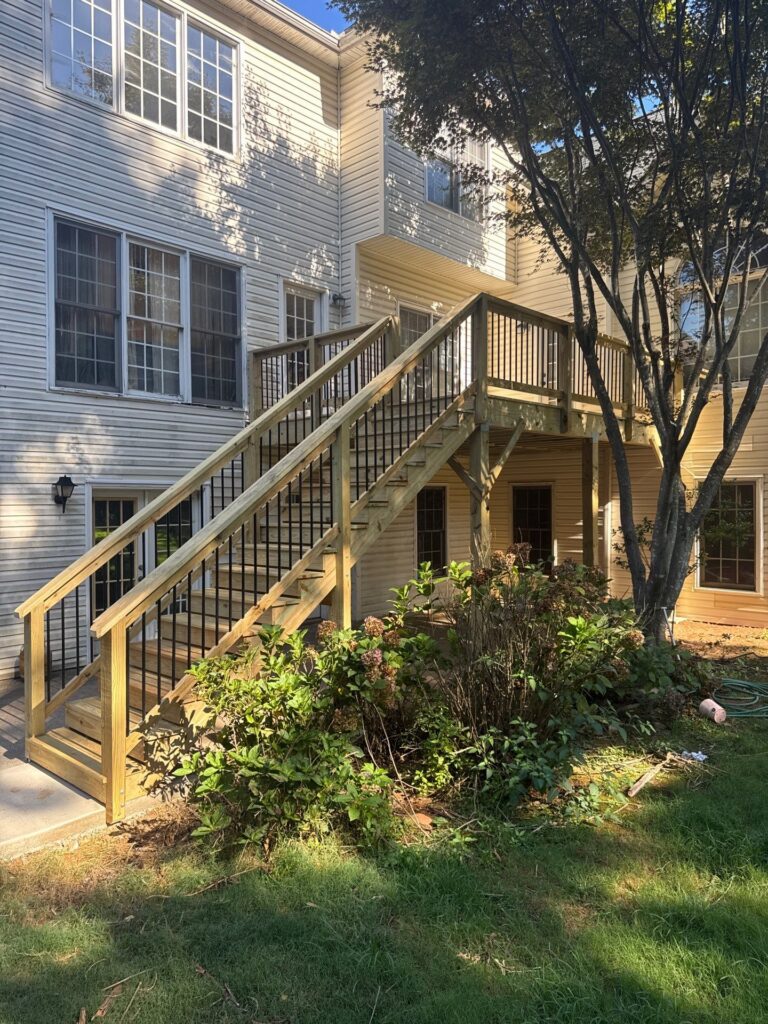
Stairs fail for similar reasons. Treads loosen or rot, stringers (the angled boards that carry the treads) soften where they meet the ground, and the whole run starts to flex. Fasteners and metal connectors hold the framing together, and over years of moisture exposure they can loosen or corrode. Corroded hardware is easy to miss because it often sits under the deck, out of view from the walking surface.
Many people also ask whether a low deck, such as one a couple of feet off the ground, needs a railing. Guard requirements depend on the deck’s height and the code your local building department enforces, so check with that office before you build or remove anything. We do not apply one rule across Metro Atlanta, because its jurisdictions do not all work the same way.
Earlier Repairs That Hid the Real Problem
Some decks fail inspection because of a repair that looked fine when it was done. We look for signs of earlier work that never addressed the original issue: new boards laid over rotted framing, a patched railing on a failing post, or fresh stain and paint over soft wood. These fixes make a deck look better for a season while the actual damage keeps spreading. An inspector who finds one of them will usually want to know what is underneath, and so do we.
We do not cover a structural problem with a cosmetic repair. If we open up a section and find that rot has moved into joists or a post, the plan changes, and we explain why before going further. Re-staining protects sound wood, but it does not fix a failed inspection item. For a wider look at what goes wrong on decks in this area, see the common deck problems we find around Metro Atlanta homes.
Repair, Rebuild or Engineer: What to Do After a Failed Inspection
A failed inspection does not automatically mean a new deck. We weigh the flagged item against the rest of the structure and the house connection described above. If the damage is limited to a few boards, a railing section or another isolated area over sound structure, a straightforward repair may be all you need. Significant structural deterioration is different, and that is when we pause routine repair work and recommend a more thorough evaluation by our licensed contractor, or by a structural engineer when the conditions call for one.
Safety comes before appearance. If the main supports or connections may be compromised, we recommend that nobody use the affected area until it is evaluated and made safe. Conditions that may justify staying off the entire deck include:
- Significant rot or deterioration in load-bearing posts, beams or joists
- A loose, damaged, separating or improperly supported ledger connection
- Movement, shifting or instability in the deck structure
- Failing footings or support connections
- Severe deterioration that makes the deck’s capacity uncertain
Smaller problems may only close part of the deck. Unstable stairs should stay off-limits until repaired, and a loose guardrail on a raised deck may justify restricting the affected area or the whole deck, depending on the condition. A damaged surface board is not the same level of concern as a failed post or house connection.
Whether a repair needs a permit depends on the scope of the work and on the county or city where the home is located. Replacing individual deck boards may be treated differently from replacing structural supports, rebuilding stairs, changing the framing or building a new deck. We evaluate the project, confirm the requirements with the local building department and coordinate the permit steps before construction begins.
For homes in Gwinnett County, we work from the county’s official building and permitting guidance, which covers footings, framing connections, ledger attachment, deck fasteners, guardrails, stairs and inspections. One public example of that work is a residential deck permit issued in Suwanee on September 12, 2022, to CANS LLC, doing business as The Trusted Toolbox. Those details are specific to Gwinnett County. The City of Atlanta, Fulton, DeKalb and Cobb counties and cities such as Norcross, Duluth and Lawrenceville may set their own requirements.
Who does the work matters once the fix is structural. The Trusted Toolbox operates under Georgia Residential Basic Qualifying Agent license RBQA006654, associated with our owner, Christopher Lalomia. You can check its current status through the Georgia Secretary of State’s license verification database.
Our team handles deck construction, repairs, wood rot mitigation, resurfacing and refinishing, and we do not refer work out. That lets us recommend a targeted repair, a larger repair or a full rebuild based on what the deck actually needs. If you are buying or selling, keep the invoices, written descriptions of the completed work, photos and any permit or inspection records. That paperwork helps both sides document what was done.
If your deck failed an inspection or was flagged on a home inspection report, schedule a deck repair evaluation and have the report or correction notice ready. We look at the structure and the house connection, not only the flagged item, and we treat each item on the report as something to evaluate rather than an automatic repair.
Deck Inspection FAQs
Do you need a permit to build a deck in Georgia?
It depends on the project and on the county or city where you live, so confirm with your local building department before work starts. New decks and structural work are more likely to need a permit than replacing a few boards. Gwinnett County publishes its own deck permit guidance, and other Metro Atlanta jurisdictions may differ.
What is considered a major issue in a home inspection for a deck?
The findings that matter most involve the structure, the house connection and the safety items: rot in posts, beams or joists, a separating or poorly attached ledger, footings that have moved, and loose railings or stairs. Faded finish and worn stain are usually maintenance items. If a report lumps them together, ask which items affect the deck’s support.
What is the 3/4/5 rule for decks?
It is a layout method for squaring corners, based on a right triangle with sides in a 3-4-5 ratio. A builder measures three units along one line from the corner and four units along the other, and if the diagonal between those marks measures five units, the corner is square. It is a construction tool, not an inspection standard.